Biogenic Content Testing under the US EPA Renewable Fuel Standard
- Fuel producers accumulate Renewable Identification Numbers (RINs) to comply with their Renewable Volume Obligations.
- Renewable fuel producers with municipal solid waste (MSW) as feedstock may use ASTM D6866 testing to measure the RIN-generating fraction of their fuels.
- Exporters also use ASTM D6866 testing to measure the renewable fuel content of blended fuels.
- RFS 2022 includes regulations for the use of biointermediates to produce qualifying renewable fuel.
- The renewable content testing standard was updated from ASTM D6866-08 to ASTM D6866-22.
Biogenic Content Testing for Partially Renewable Fuel
 Under its Renewable Fuel Standard Program, the U.S. Environmental Protection Agency (EPA) allows fuel producers using separated municipal solid waste (MSW) as feedstock to generate Renewable Identification Numbers (RINs) that they use to demonstrate compliance with their Renewable Volume Obligations.
Separated MSW is described in the RFS as “material remaining after separation actions have been taken to remove recyclable paper, cardboard, plastics, rubber, textiles, metals, and glass from municipal solid waste, and which is composed of both cellulosic and non-cellulosic materials.”
Under the RFS, the biogenic fraction of the MSW-derived renewable fuel, as determined by ASTM D6866 testing, qualifies for RINs having a D-code of 3. The calculation of the renewable fraction of the fuel is based on ASTM D6866 test results for every batch of fuel produced. Alternatively, testing is done on a composite sample obtained from different batches produced over a period not to exceed one calendar month.
The resulting biogenic fraction of the composite sample will be deemed cellulosic biofuel and applied to all batches of fuel produced in the next month to determine the appropriate number of RINs that must be generated. The fuel producer is required to recalculate this fraction at least monthly. For the first month, the fuel producer can estimate the non-fossil fraction and then make corrections as needed in the second month.
The procedure using the ASTM D6866 method applies not only to MSW-derived fuel but also to all partially renewable transportation fuels produced by the simultaneous co-processing of renewable biomass (as defined in the RFS) and non-renewable feedstock. ASTM D6866 testing is required under Method B, which is used to calculate the number of gallon-RINs generated for a batch of partially renewable fuel.
Sources: Pages 14706 and 14876 of the RFS2 (PDF) published in March 2010
ASTM D6866 Testing for Blended Fuels
The RFS also contains a provision for exporters of blended fuels (renewable fuel mixed with gasoline or diesel) on how to determine the percentage of renewable fuel in the blend.
According to the US EPA, for renewable fuels that are in the form of a blend with gasoline or diesel at the time of export, the exporter shall determine the volume of exported renewable fuel based on one of the following:
(1) Information from the supplier of the blend of the concentration of renewable fuel in the blend.
(2) Determination of the renewable portion of the blend using Method B or Method C of ASTM D6866 or an alternative test method as approved by the EPA.
(3) Assuming the maximum concentration of the renewable fuel in the blend as allowed by law and/or regulation.
Source: Page 14880 of the RFS2 (PDF)
Biointermediates Allowed in RFS Program
The 2022 RFS update includes a regulatory framework allowing biointermediates to be included in the program while ensuring that environmental and programmatic safeguards are in place. Any feedstock material intended for use to produce renewable fuels must meet all requirements set by the 2022 RFS program to be accepted as a biointermediate. To date, only these materials are eligible – Biocrude, Biodiesel distillate bottoms, Biomass-based sugars, Digestate, Free fatty acid (FFA) feedstock, Glycerin, Soapstock, or Undenatured ethanol.
Under the program, RIN-generating parties must calculate RIN volume for co-processed fuels produced from a biointermediate and calculate the renewable fraction of a fuel using ASTM D6866 Method B (Accelerator Mass Spectrometry). If the renewable content of the co-processed fuel is 10% or greater, the ASTM D6866 Method C standard can be used.
Source: Page 39664 of RFS FR Doc. 2022–12376 (PDF)
2023 UPDATE: The EPA expanded the use of biogas as a biointermediate and RNG as a feedstock.
For more details: RFS Program Adds Biogenic Content Testing for Biogas and RNG
Renewable Fuel Standard Overview
The RFS program establishes specific volume standards for cellulosic biofuel, biomass-based diesel, advanced biofuel, and total renewable fuel that must be used in transportation fuel each year. The EPA annually calculates the value of the annual standards and publishes these values in the Federal Register.
The program aims to decrease dependence on foreign crude oil imports while increasing domestic sources of energy, reducing greenhouse gas emissions, improving air quality, and diversifying the country’s energy portfolio.
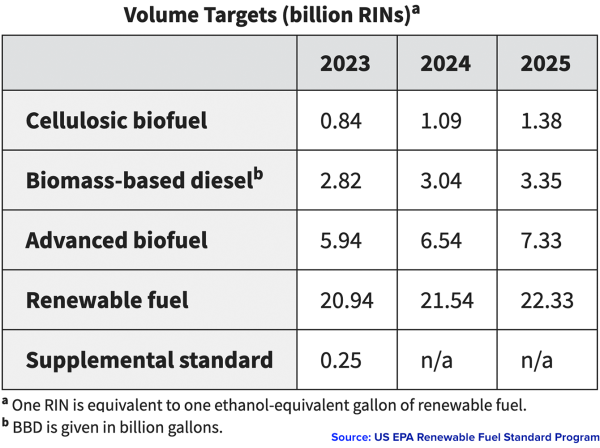
The regulatory requirements apply to domestic and foreign producers/refiners and importers of renewable fuel. Exporters of renewable fuels, whether in its neat form or blended with gasoline or diesel, acquire RINs to comply with their applicable Renewable Volume Obligations. Refiners, importers, and exporters of renewable transportation fuel retire RINs for compliance purposes. RINs have monetary value and are tradable. Parties can buy RINs to meet their obligations or sell their extra RINs.
Source: US EPA: Renewable Identification Numbers (RINs) under the Renewable Fuel Standard Program
Beta Analytic’s Rapid ASTM D6866 Testing Services
Based in Miami, Florida, Beta Analytic aims to help renewable fuel producers and exporters in complying with the RFS by providing accurate and precise ASTM D6866 testing. The ISO/IEC 17025:2017-accredited laboratory provides results in 7 business days or less. Faster services are also available. For inquiries, contact the lab using this form.
Beta Analytic provides ASTM D6866 testing for transportation fuels. The lab is not affiliated with the US EPA or the Renewable Fuel Standard (RFS) Program.
Page last updated: August 2023