ISO 16620 – Biobased Content Testing of Plastics & Other Products
Measuring % Biobased Carbon vs % Fossil Carbon
- ISO 16620 measures the biobased carbon content of plastic products, polymers, and additives.
- Using Carbon-14 analysis, this standard can also be used to verify the natural source versus petrochemical-derived components of flavors, fragrances, supplements, beverages and other products.
- SGS Beta provides fast and accurate ISO 16620-2 testing.
ISO 16620 Standard for Plastics
 The International Organization for Standardization (ISO) published a series of standards focused on the biobased content of plastics. One of the standards can determine the exact percentage of carbon in the plastic material that comes from renewable sources or biomass:
- ISO 16620-2:2019 Plastics — Biobased content — Part 2: Determination of biobased carbon content
ISO 16620-2 requires Carbon-14 analysis and expresses biobased carbon content as a fraction of sample mass, total carbon content, or total organic carbon content. This standard is applicable to plastic products, polymer resins, monomers, or additives, which are made from biobased or fossil-based constituents. The standard is available for download at the ISO website for a fee.
How does ISO 16620-2 detect Petroleum-derived Synthetic Substances in Natural Ingredients?
ISO 16620-2 detects artificial substances in materials through Carbon-14 analysis. Materials sourced completely from biomass (such as plant extracts) have a known Carbon-14 level and will be 100% biobased, according to ISO 16620-2. On the other hand, materials wholly made from petroleum-derived components have no Carbon-14 and will be 0% biobased. A product made of biomass and petroleum-based raw materials will have a biobased content between 0% and 100%, depending on the quantity of each component in the product.
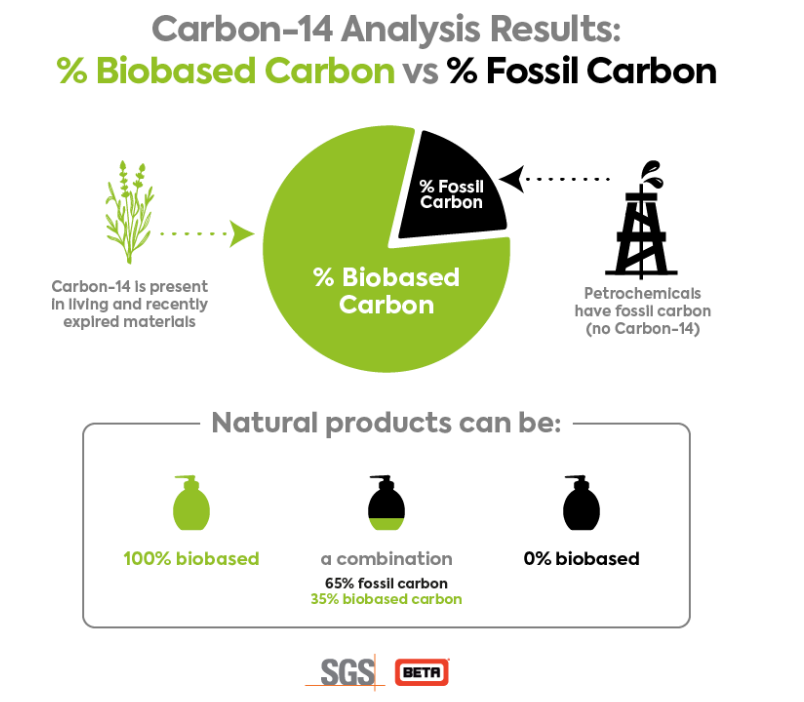
ISO 16620-2 does not differentiate whether the natural product is sourced from specific plants, animals, or microbiological materials. It is not a content specification analysis. The ISO 16620-2 report shows the percentage of a product that comes from natural sources (biobased content) versus synthetic petroleum-derived content.
Ready to submit your products for ISO 16620-2 testing?
Sample sizes, recommended containers and other details are found in our submission guidelines for Plastic Products and Natural Ingredients.
SGS Beta’s High-Quality ISO 16620-2 Testing Services
Our ISO/IEC 17025:2017-accredited laboratory routinely reports results with quality assurance reports included on your personal online account in 7 business days or less. A priority service is available for results required in 4 business days or less.
Customer support is available in English, Chinese, French, German, Italian, Japanese, Korean, Portuguese, and Spanish.
Results Reported according to ISO 16620-2 Method C
SGS Beta uses accelerator mass spectrometry (AMS), referred to as Method C in the ISO 16620-2 standard. We measure isotopic ratios and report results according to ISO 16620-2 8.3.2: biobased carbon content as a fraction of Total Carbon or Total Organic Carbon. We do not report Carbon-14 results as a fraction of Total Carbon by mass.
SGS Beta is not affiliated with ISO or its technical committees.
HIGH-QUALITY LAB
SGS Beta offers standard and priority services for ISO 16620 testing.
Request PricingPage last updated: November 2025